For NZ borrowers, the main concern is often: will closing an old credit card hurt my credit report or my next borrowing application? The truth is the closure won’t disappear your account details—lenders see when an account was opened, repayment history, and the date it was closed. The closure itself appears on your credit report after your provider tells the bureau, so it can take some time. The most critical piece is not the closure but whether you’ve paid it off, kept your broader finances in check, and minimised bursts of new applications.
In practice, your repayment record, total open accounts, and lack of recent rushed applications speak much louder than a single closed card—so don’t over-invest in perfection. Instead, use this as a chance to check your report, tidy your borrowing, and use loan comparison tools that don’t add noise to your file.
What really changes the cost and likelihood of your next loan approval isn’t just that you closed a card—it’s what your credit file looks like at that moment. Here are the most important changes and influences:
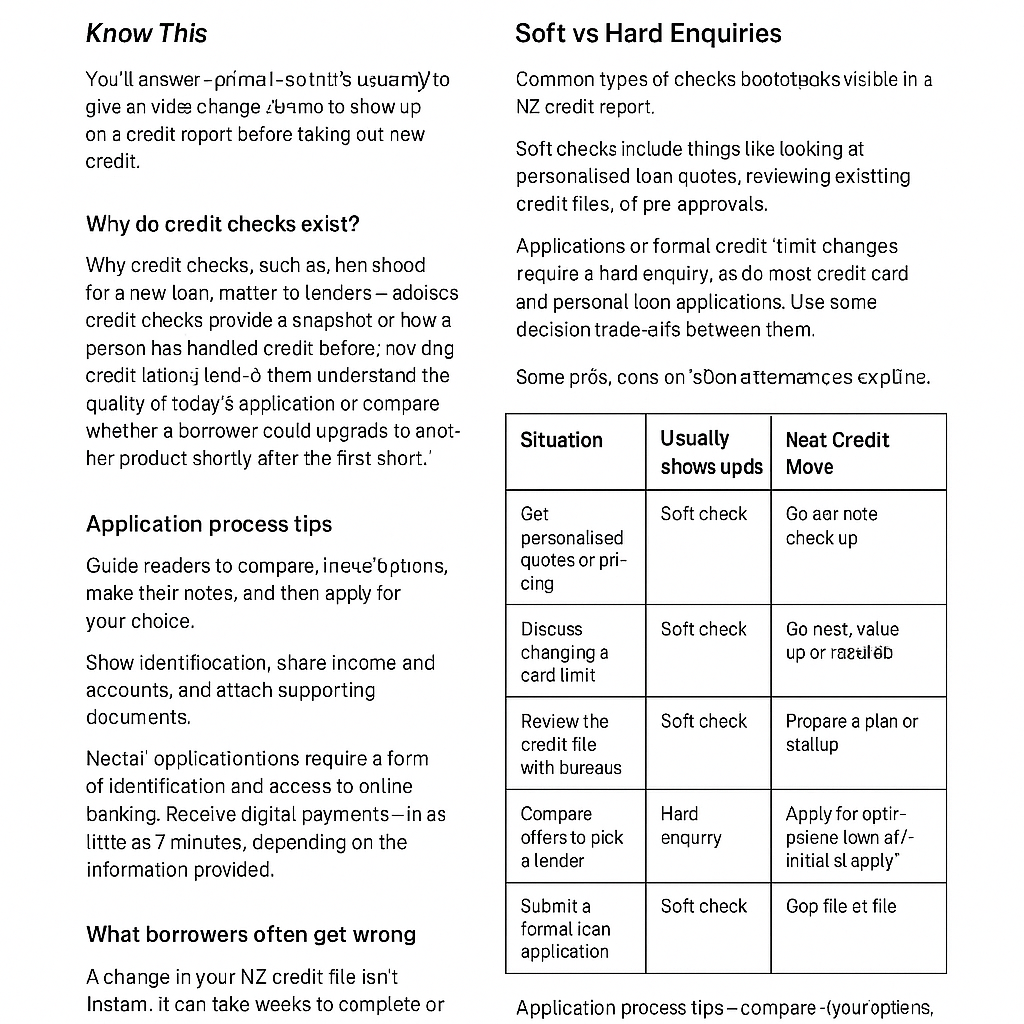
Soft checks are best for exploring options and rates; formal applications should come only after you’ve settled on your preferred provider and tidied up your credit report.
| Situation | Usually better fit | Why or trade-off |
|---|---|---|
| Comparing loan quotes (soft check) | Early in your research | No hard enquiry, safe to check options and pricing before applying |
| Making formal loan applications | Only when ready | Hard enquiries are visible and can affect lender perception if too frequent |
| Closing an old credit card | After balance is paid | Tidies up available credit, but closure remains visible; payment history stays on file |
| Keeping a zero-fee card open | No expected borrowing soon | Keeps credit limits available and file longer, only if card won’t tempt further spending |
| Applying for multiple loans quickly | Avoid | Lenders see multiple hard enquiries; can impact pricing and approval for future borrowing |
| Reviewing credit file before a big loan | Always recommended | Guarantees your record is accurate and reflects current account and closure status |
Picture someone in Canterbury with an old credit card—they haven’t used it in a while but want to tidy loose ends before applying for a car loan. The card has no outstanding balance. They formally request the bank to close it, get written confirmation, but know the closed status might take a few weeks to reflect on credit reports. They use Nectar’s digital process to compare loan quotes (soft check, no formal hard enquiry) and wait until their report shows the closure before submitting a formal application. As a result, their file appears stable—only one hard enquiry for the new loan, no recent flurry of applications, and a clearly closed historic card with a clean repayment record.
Contrast this with a friend who closes a card then panics and applies for a string of personal loans, overdrafts, and car finance within days. The result is several hard enquiries, muddied signals for lenders, and possibly higher rates than needed—or even being declined. Timing and order matter more than most borrowers realise.
Sometimes, leaving an old credit card open actually benefits your credit file, especially if it has no annual fee and isn’t a temptation. Keeping it can help your file look more established (longer history, higher available credit). Closing a card is best when:
A personal loan isn’t always the fix, either. Consider an overdraft, lower credit card limit, or no-borrowing period if you’re mainly seeking flexibility, don’t need a lump sum, or want to avoid formal application noise. Nectar loans make sense chiefly for consolidating more expensive debts, a planned one-off major purchase, or smoothing repayments—if not, waiting or simpler banking steps often suit better.
Nectar’s digital-first platform gives borrowers a chance to see their personal loan options without cluttering their credit file with unnecessary entries. You can:
If you’re sorting out older debts, replacing a car after a failed WOF, or just cleaning up before a big move, Nectar gives you insight without panic or commitment.
Take your next step with a personalised loan quote or check likely repayments with our loan calculator. Only commit to a formal application when you’re sure of your decision and your credit file is in order.
It depends on your provider and the credit reporting bureau’s update schedule, but expect a few reporting cycles before it appears. Always check your file is updated before applying for new credit.
Not usually. The bigger factors are repayment history and total borrowing activity. Closing a card only drops your available credit and shortens your open credit history if it was your oldest account.
A soft check is used for research and comparison (like getting a loan quote), and other lenders don’t see it as a formal application. A hard enquiry results from an actual application and can be visible to other lenders, affecting how they view your file.
If there are no fees and it doesn’t tempt you to overspend, leaving it open can keep your credit history longer and available credit higher. Close it if it costs you or you simply want to simplify your finances.
Rushing to make new applications before your credit file updates, or closing accounts with outstanding balances, is more likely to hurt your borrowing profile than the closure itself.
Don’t guess when it comes to your credit file—be deliberate. If you’re planning a loan or paying off multiple debts, check your rate or use Nectar’s tools to compare before making a formal move. Keep your credit file in shape and control the timing of your next application for the smoothest experience.
* Nectar Money offers competitive unsecured personal loan rates with fixed interest rates from 7.95% to 29.95% p.a., based on your credit profile. A $240 establishment fee and $1.75 administration fee per repayment apply. Strong Credit borrowers may qualify for low, competitive rates from 7.95% to 11.95% p.a.; Good Credit borrowers may qualify for rates from 14.95% to 22.95% p.a.; and Fair or Developing Credit borrowers may qualify for rates from 24.95% to 29.95% p.a. The broad range helps Nectar offer low interest rates to borrowers with excellent credit, while also providing loan options for more New Zealanders, including borrowers with fair or developing credit profiles. Learn more here.
All loans are subject to responsible lending checks and standard borrowing criteria. Please see our privacy policy and rates and terms, or visit our FAQs for the most up to date information. This publication is provided for general information purposes only and does not constitute legal, tax, financial, or other professional advice from Nectar Money. It is not intended as a substitute for obtaining advice from a financial adviser or any other qualified professional. We make no representations, warranties, or guarantees, whether express or implied, that the content in this publication is accurate, complete, or up to date.