Should You Use a Personal Loan to Pay Off High-Interest Credit Card Debt? Real Decisions for Kiwi Borrowers
Quick answer
Personal loans can reduce the total cost of clearing high-interest credit card debt if the rate and fees are genuinely lower than your current structure—always check using a repayment calculator before deciding.
Fixed repayments on a personal loan create discipline and predictability, but lose some of the flexibility of a credit card or overdraft—consider your job security and budget resilience first.
Overdrafts and credit cards offer short-term flexibility but are risky for ongoing balances due to compounding fees and unclear end dates.
Use the total amount repaid—not just the weekly or monthly payment—as your main decision tool; delaying or reducing expenses is often smarter than taking on new debt.
Personalised loan quotes from Nectar may be available in as little as 7 minutes (depending on your information), but approval and funding require full responsible lending checks—process clarity and total cost matter as much as speed.
The decision in plain English
If you’re carrying a stubborn credit card balance, it’s easy to feel stuck between two uncomfortable choices: stick with high ongoing interest, or change structure and add a new loan. In New Zealand, the choice often comes down to whether you’d benefit more from flexibility now or a clear path out of debt.
Credit cards and overdrafts are built for flexible spending—and when used carefully, they help smooth cash flow. The downside? Leaving an ongoing balance exposes you to daily interest charges, compounding fees, and the temptation of minimum payments that rarely make a dent.
Personal loans, by contrast, force structure: you have fixed repayments, a fixed term, and a clear finish line. That’s a major plus if you want to get off the revolving-debt treadmill. But loans come with their own setup fees and less wiggle room if your finances suddenly change. The wrong structure for your situation can end up costing more, not less.
Rule of thumb: Prioritise the structure that gives you both a lower total repayment and fits your income certainty. Convenience or flexibility often means a higher overall cost, while fixed terms reward discipline.
What changes the total cost
Total cost isn’t just about interest rates—it’s about everything you’ll repay, including hidden or one-off fees. Here’s what shifts the real-world outcome:
Interest rates: Personal loans typically offer lower rates than standard credit cards. But always verify—the advertised rate may not be your actual personalised rate, and additional fees can close the gap.
Fees: Establishment, admin, and ongoing account fees add up. Don’t just compare headline rates—factor in all disclosed fees using a comprehensive repayment calculator, like this one from Nectar.
Repayment term: A longer term means lower weekly costs but a larger total repayment. Finding the shortest term you can reliably handle helps reduce wasted interest.
Changing behaviour: If you get a loan, stop using the card. Doubling up on the same debt ruins the original purpose.
Stability: If you might face income drops—say, your job is contract-based or family expenses are rising—a structure with payment flexibility (but tight discipline) may be safer.
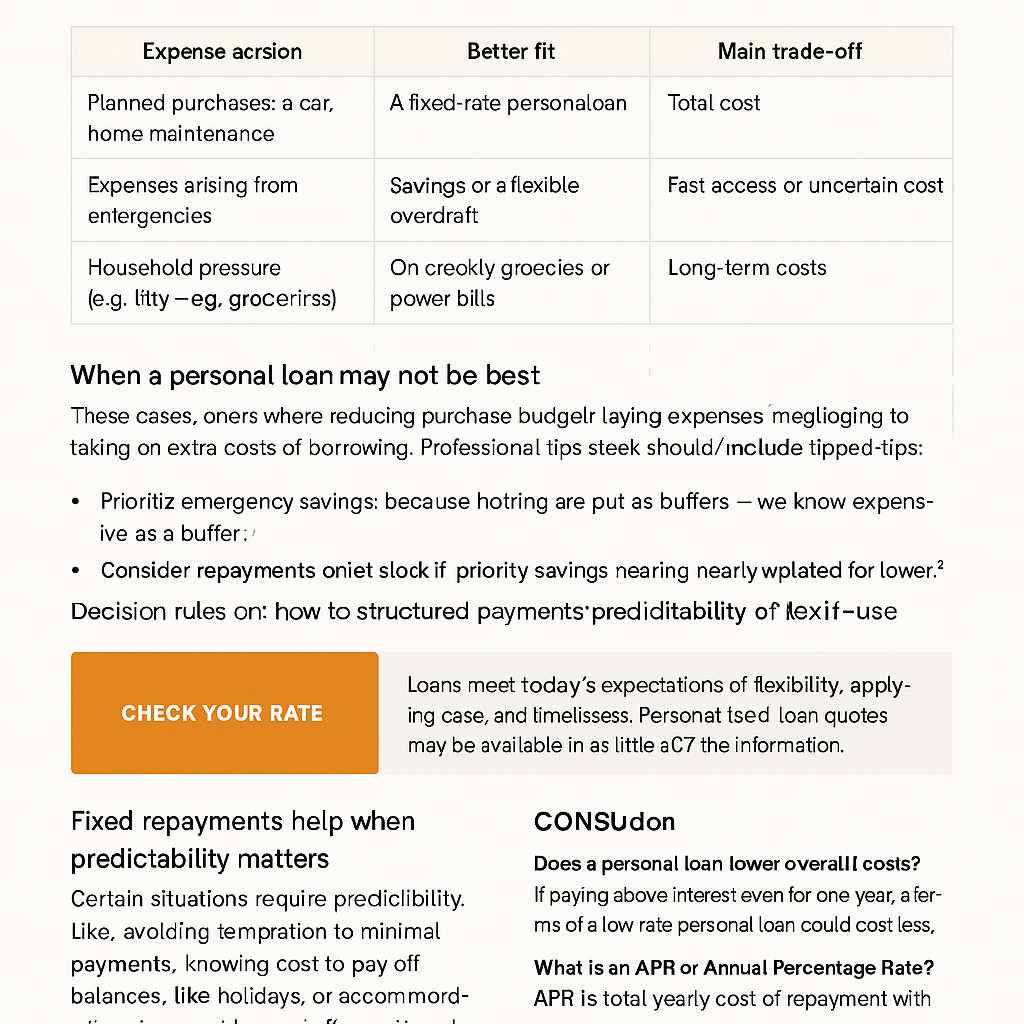
Comparison table
Situation
Usually better fit
Why or trade-off
Clearing persistent credit card debt
Personal loan
Lower total cost, fixed end point, disciplined payoff
Draining debt quickly after a small emergency
Emergency savings
Avoids added interest and fees, preserves flexibility
Managing uncertain income or unstable expenses
Overdraft or credit card
Flexibility if cash flow is variable, but more expensive over time
Large, planned purchase (appliance, repairs)
Personal loan
Predictable repayments, often cheaper than card
Minor, recurring cash gaps
Reducing expenses
Adjusting budget avoids fees and revolving interest
Urgent WOF or car repair, no savings left
Overdraft (short term)
Fast access, but high rates—clear the balance ASAP
A realistic New Zealand scenario
A Christchurch family relies on one car for school runs, work commutes, and weekly shops. Over the past year, unexpected mechanics’ bills and seasonal expenses have led to a gradual climb in their credit card balance. The minimum payment keeps the pressure off for now, but with interest rates on the card, the total just isn’t going down much month to month.
They consider a personal loan, using Nectar’s online repayment calculator to model three options: pay down as fast as possible, spread over a longer term with easier weekly payments, or try to chip away with the card as they have been. The middle ground—the shortest loan term they can realistically commit to—looks best for long-term savings, even though the committed payment means less monthly buffer if another emergency arises.
Recognising that simply shifting debt isn’t a miracle fix, they resolve to put away the card after consolidating and to rebuild some emergency savings once payments are under control.
When another option may be better
There are situations where a personal loan—from Nectar or anyone—simply isn’t the best move:
When emergency savings still have headroom
Using savings to pay off high-interest debt nearly always wins on total cost, if doing so won’t leave you exposed to the next emergency. It’s wise to maintain at least a small buffer for real emergencies, but consider deploying savings strategically if debt is draining your resources.
When you can reduce or delay the expense
Sometimes the smartest move is to downsize, wait, or cancel a planned purchase instead of borrowing more. If you can patch that old appliance a little longer or put off a holiday, you not only skip new debt—you may lower your total monthly outgoings and stress.
When repayments would stretch you too thin
If locking in fixed repayments would risk essentials—like rent, food, or minimum living costs—think hard before switching to a loan. In those cases, keeping flexibility and prioritising minimum payments until your situation stabilises might be safer. Temporary use of an overdraft or tight budget cuts can help, but should be seen as a short bridge, not a way of life.
Practical checklist
List all current debts: Note balance, interest rates, and minimum payments for your credit cards, overdrafts, and any loans.
Use a reputable repayment calculator: Try Nectar’s loan calculator to compare total cost and payment timelines for each option.
Assess your financial stability: Is your income steady enough to handle a fixed monthly or weekly repayment? Will this commitment crowd out essentials?
Check your discipline around credit use: Are you prepared to avoid running up the credit card again if you consolidate?
Read the fee disclosure and terms (before you apply): Check the full Nectar rates and terms, including all fees—not just estimates, but real numbers for your loan size.
Review your alternatives: Could you delay, split, or downsize the expense to lower the amount you need to borrow?
Plan for surprises: If you expect any life changes (job switch, new expenses), what’s your backup? Consider keeping a small buffer.
Get a personalised quote: Only after working through the above, consider a no-commitment Nectar quote (soft check, not a full application).
Ask for help if unsure: Use advice resources, or reach out to Nectar’s team or a registered financial adviser if the numbers don’t feel right.
Where Nectar can help
Nectar’s digital-first approach simplifies the process for Kiwis wanting to map out their debt structure with less paperwork and more transparency. If a personal loan looks like the right fit for your credit card or card-plus-overdraft debt, Nectar can deliver a personalised loan quote in as little as 7 minutes (depending on the information you provide). That quote will show an indicative rate and all fee elements—putting you in a position to compare real costs before you take the next step.
Use the online calculator to model different amounts and terms for your scenario.
Applications are digital and designed for clarity: you’ll need to provide ID, bank statements, and income details for a proper responsible lending assessment.
If your situation is unclear or you have questions, Nectar’s support team offers practical help, aiming for real NZ understanding—not a scripted push for an application.
If in doubt, ask: Does the structure lower your total repayment and still fit your budget every week? If not, delay, downsize, or use savings instead—a personal loan should be a specific solution, not a default.
FAQ
How do I know if a personal loan will actually save me money compared to paying off my card?
Use a repayment calculator to add up the total cost—including interest and all fees—over the full term for both options. Only switch if the new structure will genuinely reduce the amount you’ll repay (and you can stick to the payment plan).
What documentation is usually required for a personal loan application in NZ?
You’ll need proof of identity (such as a NZ driver’s licence or passport), recent bank statements, and proof of income (such as payslips or benefits statements). Be prepared for digital submission if applying online with lenders like Nectar.
Is it safe to check my quote—will it mark my credit file?
Personalised loan quotes from reputable NZ lenders like Nectar generally use a soft credit check, which is not treated by bureaus in the same way as a full application enquiry. For full applications, expect a formal credit enquiry as part of responsible lending. If timing is important for a major purchase, check that your credit file is current.
Can I use my credit card again after paying it off with a loan?
Technically yes, but you risk falling back into the same debt trap. The smartest move is often to cut up, stash, or freeze the card until you’ve rebuilt your savings or changed your habits.
When is an overdraft a better choice than a personal loan for card debt?
Sometimes, for a brief cash flow blip (such as a short gap before salary or benefit comes in), an overdraft’s flexibility helps. But if you carry a balance week after week, fees and interest snowball fast—making it a costly long-term habit.
Next step
Ready to compare? Get a personalised quote with Nectar and check your total repayment structure in as little as 7 minutes, depending on the information you supply. Use the calculator, read the terms, and ensure you’re making the smartest move for your debt and your future.
* Nectar Money offers competitive unsecured personal loan rates with fixed interest rates from 7.95% to 29.95% p.a., based on your credit profile. A $240 establishment fee and $1.75 administration fee per repayment apply. Strong Credit borrowers may qualify for low, competitive rates from 7.95% to 11.95% p.a.; Good Credit borrowers may qualify for rates from 14.95% to 22.95% p.a.; and Fair or Developing Credit borrowers may qualify for rates from 24.95% to 29.95% p.a. The broad range helps Nectar offer low interest rates to borrowers with excellent credit, while also providing loan options for more New Zealanders, including borrowers with fair or developing credit profiles. Learn more here.
All loans are subject to responsible lending checks and standard borrowing criteria. Please see our privacy policy and rates and terms, or visit our FAQs for the most up to date information. This publication is provided for general information purposes only and does not constitute legal, tax, financial, or other professional advice from Nectar Money. It is not intended as a substitute for obtaining advice from a financial adviser or any other qualified professional. We make no representations, warranties, or guarantees, whether express or implied, that the content in this publication is accurate, complete, or up to date.